
Cedar Hill Homeowner Guide
Ceiling Water Damage by Season in Cedar Hill
Ceiling water damage in Cedar Hill follows the calendar. Spring brings the storms that open roofs. Summer runs the attic air conditioner until its drain line clogs and drips for weeks. Winter brings the hard freeze that splits a pipe, and the thaw that pours it through the ceiling below. The season you are in is the first clue to where the water came from, because each season fails a different part of the house.
Hold that clue loosely, though. A season is a clue, not proof. A stain in April is usually storm related, but usually is not always, and repairing the ceiling before the source is confirmed just books the same repair twice. The assessment settles it: a moisture meter reads the board and the insulation, and thermal imaging shows where the wet path actually runs.
Spring
Storms, Hail and Openings in the Roof
Spring in North Texas means severe storms rolling across Dallas County and Ellis County, large hail, and wind strong enough to lift shingles and flashing. Hail bruises and cracks shingles, wind peels an edge back, a limb comes down through the deck, and the next rain has a straight path into the attic and onto the ceiling below. Gutters overwhelmed by a hard rain can also push water back under the roof edge.
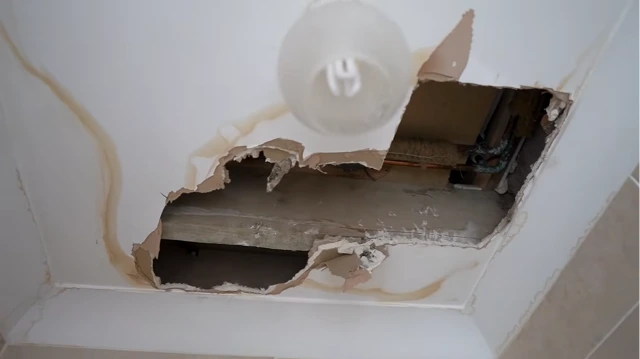
A stain or an active drip that lines up with the weather. It leaks while it rains, slows when the rain stops, and stays quiet through a dry week. The mark often sits below a valley, a vent, a chimney flashing or the slope that took the hail.
Stay clear of a ceiling that is bulging or sagging under pooled water, because wet drywall gets heavy and can come down. If water is coming through a light fixture, treat the electricity as part of the hazard and keep hands off switches in that room. Photograph everything while it happens, dates included; a spring storm claim turns on the timeline. Our insurance guide walks through how Texas insurers read a storm opening claim. A roofer handles the roof itself. We repair the ceiling and its water damage once the way in is closed, and emergency drying can start before either repair.
Why does my ceiling leak only when it rains?
Because the water is coming from above the roof deck, and rain is the only supply. A leak that starts and stops with the weather points at a roof opening, failed flashing or an overflowing gutter, not at a pipe, because pipes leak on dry days too. Note which rains set it off: a wind driven rain from one direction can find a lifted shingle edge that a straight down rain never reaches. Tell the assessor that pattern; it narrows where on the roof the opening sits.
Summer
The Attic AC Works All Day, and Its Drain Gives Up
Summer is the condensate season, and around Joe Pool Lake the humidity loads every attic in Cedar Hill a little harder. The air handler sits in the attic in most homes here, pulling a steady stream of water out of the indoor air. That water should leave through a condensate drain line. When algae and sludge clog the line, or the drain pan cracks, or the float switch fails to shut the unit down, the overflow lands on the ceiling below, drip by drip, for as long as the AC runs.
A slow growing stain or a drip near the unit, often below an air vent, that appears in the heat of the summer and was not there in May. Because the drip is small and steady, the insulation above the board can be soaked long before the stain breaks through the paint.
Switch the AC off at the thermostat if you can do it safely. That stops the unit making more condensate, and it is the one move that slows a summer leak on the spot. Do not keep running the unit and mopping; a clogged line does not clear itself. The drain line, the pan and the switch belong to an HVAC technician. Drying the ceiling cavity and repairing the board and insulation belong to us, and fast drying keeps that repair small. The drying guide explains how that process is measured.
Why is my ceiling wet in summer when it has not rained?
In a Cedar Hill summer, the first suspect is the air conditioner, not the sky. Attic units drip condensate every hour they run, and a clogged drain line sends that water onto the ceiling instead of outside. A wet ceiling under a running attic unit, in a dry week, is the condensate pattern. The second suspect is an attic plumbing line or the water heater many homes here keep overhead, which is why the assessment reads the whole cavity instead of assuming.
Fall
The Quiet Season, and the One That Gets You Ready
Fall is the calmest stretch of the year for ceilings in North Texas, and the most useful. Storms ease, the AC finally rests, and the house gets a few months before the first cold snap tests every pipe in the attic. Use the quiet. The ceilings that fail in January often carry a warning from October: a faint summer stain that never got measured, a condensate line that clogged once and will clog again, shingles the spring hail bruised that one more winter will finish.
What to check in the fall
- Walk the house and look up. Note every stain, ring and paint bubble, even faint ones, and get the questionable ones read before the holidays.
- Have the AC serviced and the condensate drain line flushed, so next summer does not start with last summer’s clog.
- Insulate exposed pipes in the attic and along exterior walls, and disconnect garden hoses before the first freeze warning.
- Have a roofer look at hail bruised or lifted shingles while the weather is mild.
- Make sure every adult in the house knows where the main water shutoff is. In a freeze, minutes count.
Fall is also when leftover damage gets found: a stain noticed while putting up decorations, a musty smell in a room that sat closed. A smell or stain that survived the summer is not a fall problem, it is an old one announcing itself, and it deserves readings, not paint.
Winter
Hard Freezes and the Burst That Waits for the Thaw
Winter is the emergency season. North Texas cold snaps hold attic temperatures below freezing for days, and water in an attic or exterior wall pipe freezes, expands, and splits the pipe wall. The cruel part is the timing: while the pipe is frozen, little or no water flows, so the house looks fine. The flood comes at the thaw, when full pressure returns to a pipe that is now open, and water runs into the ceiling cavity until someone shuts it off. Homes near U.S. Highway 67 and FM 1382, lakefront homes around Joe Pool Lake and older homes across southern Dallas County all see the same pattern in the same cold week.
Trouble that arrives suddenly, hours after the temperature climbs. A fast growing stain, a drip that becomes a stream, a ceiling that bulges as water pools on top of the drywall. This is also the season of the ceiling that comes down, because pooled water is heavy and saturated board loses its grip on the joists.
Shut the water off at the main valve first, before anything else, if you can reach it safely. Water from a burst pipe spreads through insulation and framing quickly, and drying wet materials within 24 to 48 hours is what helps prevent mold growth, per U.S. EPA guidance. Our emergency page sets out the first moves in order. A plumber replaces the split pipe section. We extract and dry the ceiling structure, take out the board and insulation that cannot be saved, and rebuild what the water ruined.
Can a pipe freeze without bursting, and still damage the ceiling?
Yes. A pipe can freeze, thaw and survive while the joint next to it weeps, or a fitting loosened by the freeze starts a slow drip days later. Freeze damage does not always announce itself in one flood. If a ceiling stain or a musty smell shows up in the weeks after a hard freeze, treat the freeze as a suspect and get the cavity read, because a slow drip from a loosened fitting can wet insulation for a long time before the board shows anything.
A Stain That Does Not Match the Season
Some ceilings refuse the calendar. A stain appears in a mild month, grows on dry days, and matches no storm, no freeze and no AC pattern. That usually means a supply line, a fitting or an upstairs bathroom is leaking on its own schedule. Timing has done its job by ruling the weather out. From there: readings across the stain and well past it, thermal imaging to trace the wet path, and opening the cavity where the readings point. The assessment page describes that visit. And if the season’s leak has already shown itself and the ceiling needs repair, the repair itself is the same careful work whatever the month: stop the source, dry the structure, save what is sound, replace what is not. Learn about ceiling leak repair.
Talk to us about your ceiling
Whatever the Season, the First Move Is the Same
Find the water, stop it if you can do so safely, and get the ceiling measured before the stain finishes telling its story. Tell us which room is affected, what sits above it, and when you first noticed the damage. We will read the full extent of it and put the scope and price in writing.
110 E Belt Line Rd, Suite 300
Cedar Hill, TX 75104
Routine hours 7:00 AM to 8:30 PM daily.
Emergency service runs 24 hours.