
Cedar Hill Homeowner Guide
Mold After a Ceiling Leak: What It Is, and What to Do About It
Mold after a ceiling leak means one thing above everything else: moisture stayed in the ceiling longer than it should have. The mold is the visible part of a moisture problem, and it has to be dealt with in that order. Stop the leak, dry the structure, then deal with the growth. Any approach that skips the first two steps fails, because mold simply returns to a ceiling that is still getting wet.
One thing should be clear from the start. Ceiling Water Damage Experts does not perform mold remediation. Texas licenses mold assessment and remediation through the Texas Department of Licensing and Regulation. We repair ceilings and dry water damage. This guide explains how to read what you are seeing, which parts of the problem are ours, and which parts belong to a licensed mold professional.
What to look for
What Mold After a Ceiling Leak Looks and Smells Like
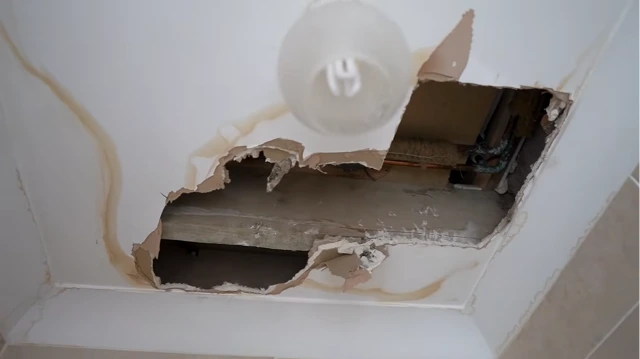
On the face of the ceiling, look for dark spots gathering at the edge of a water stain, patches of green, grey or black that spread slowly week by week, and paint that bubbles or peels over the same spot again after it has been painted once already. A stain that was only a stain, and now has spots growing out of it, has changed its nature.
The smell usually arrives first. A musty, earthy odour in the room that gets stronger after rain, after the air conditioning has run, or when the room has been closed up for a day is often the earliest sign. Follow the water’s path to understand why: the leak wets the insulation, the insulation holds that water against the back of the drywall, and that is where growth starts, in the dark, still cavity above the board. By the time spots show through the paint on the room side, the material above has usually been damp for a while.
How fast can mold grow after a ceiling leak?
Fast enough that drying speed is the whole defence. The U.S. EPA advises that mold can begin growing on wet materials quickly, and that drying wet materials within 24 to 48 hours helps prevent mold growth. A ceiling cavity that stays wet for days, because the insulation above the board is holding water, gives mold the three things it needs: moisture, still air and material to feed on.
The right order
Why the Leak and the Drying Come First
Mold needs moisture more than it needs anything else. Clean growth off a ceiling that is still leaking and it comes back, because the water and the food are both still there. The order that works is the order the job actually runs in: the source is stopped by its own trade, a plumber for a pipe, a roofer for a roof opening; the structure is then dried and the drying verified with readings; and only then is the growth itself assessed. Our ceiling drying work is that middle step, and it is also the prevention step. A ceiling brought to its drying goal, checked against ANSI/IICRC S500, no longer has the excess moisture that supports continued growth.
Stop the source
A plumber or roofer addresses the pipe or roof opening that is letting water in.
Dry the structure
Check affected materials and verify drying with moisture readings.
Assess the growth
A qualified mold professional determines the scope of any mold work.
When to get specialist help
Small Surface Mold vs. a Licensed Job
The U.S. EPA draws a practical line for homeowners. A mold area smaller than about 10 square feet, roughly a three foot by three foot patch, can often be handled by the homeowner: cleaning the surface, and fixing the moisture source that fed it, which is the part that actually decides whether it returns.
Call a licensed mold professional instead when any of these is true:
- The area is larger than about 10 square feet, or spots are appearing in several places at once. Texas has a separate 25 contiguous square foot licensing threshold for non-exempt mold projects; homeowner exemptions can apply.
- The growth is inside the ceiling cavity, on the insulation or the framing, which is where ceiling mold usually lives and where a surface wipe cannot reach.
- The mold keeps coming back after cleaning, which means the moisture feeding it is still there.
- The air handler or ductwork sits above the ceiling or close to the growth; an HVAC system can move spores from one room to the whole house.
- Anyone in the home has breathing difficulties or a weakened immune system; take extra care, keep time in the room limited until it is assessed, and let a licensed professional handle the work.
Does Texas require a license for mold remediation?
Texas licenses mold assessment and remediation through the Texas Department of Licensing and Regulation. For a non-exempt remediation project involving 25 contiguous square feet or more of visible mold, a licensed professional is required. The Occupations Code (Section 1958.102) also provides exemptions, including certain work by a homeowner on their own residence. The EPA’s 10 square foot line is practical cleanup guidance, not the Texas licensing threshold. If you hire a mold professional, check their TDLR license and ask what inspection and documentation the project requires.
Professional mold work
What a Licensed Remediation Involves
At a high level, a licensed remediation on a ceiling runs in this order:
- Assessment. A licensed mold assessment finds how far the growth has spread, including inside the ceiling cavity, and sets the scope of the work.
- Containment. The work area is sealed off, so spores disturbed during removal do not travel into clean rooms.
- Removal. Porous material that mold has grown into, stained drywall and soaked insulation, usually comes out; it cannot be cleaned back to sound. Framing and hard surfaces can be cleaned.
- Drying and verification. The structure is dried and checked, and on insured jobs an inspection confirms the removal and a certificate of mold removal is issued.
Where our work fits is before and after. Before: finding and measuring how far the water spread, which is what our leak assessment does. After: once a licensed professional has cleared the area, rebuilding the ceiling, new insulation, drywall, texture and paint matched to the rest of the room, is ceiling repair, and that is ours. See ceiling leak repair.
Insurance questions
What Insurance Says About Mold After a Leak
The Texas Department of Insurance draws its line at the cause, the same line it draws for the water damage itself. If mold develops on an item damaged by a covered event, a burst pipe for example, that damage would be covered. Mold that follows a gradual leak or a flood is not covered, because the cause was not covered. Mold cleanup and testing as a separate service are usually not included in a policy, though that coverage can often be added. Our insurance guide walks through how Texas insurers read a ceiling claim from the first phone call.
Common questions
Questions Cedar Hill Homeowners Ask About Mold
Can I just bleach the mold on my ceiling?
Bleach is a weak answer on drywall. It lightens the surface colour while the growth inside the porous board, and the moisture feeding it, stay untouched, and the water in the bleach itself adds to the damp. On a small patch on a hard, non-porous surface it can clean the surface. On ceiling drywall, the honest order is to fix and dry the moisture first, and anything beyond a small area belongs to a licensed professional.
Will mold come back after the ceiling is repaired?
Not if the moisture is gone. Mold returns when it still has water: a leak that was never fully fixed, insulation left wet inside the cavity, or materials closed up before readings showed them dry. A repair that starts with verified drying, and replaces the material that cannot be saved, removes what mold needs to live on.
Is the mold on my ceiling a health emergency?
Treat it as a problem to act on promptly, not a reason to panic. Some people are more sensitive to mold than others. A large area, growth near the air handler, or anyone at home with breathing problems or a weakened immune system are all reasons to bring in a licensed mold professional sooner and keep time in the room limited meanwhile. For questions about your own family’s health, a doctor is the right call. Our job is the moisture and the ceiling.
We Handle the Ceiling. A Licensed Professional Handles the Mold.
If your ceiling has been wet, or a stain is growing spots or a musty smell, start with the moisture. Tell us which room is affected, what is above it, and how long it has been damp. We will map how far the water spread and put the scope and price in writing. The assessment is a paid visit, and the fee is confirmed before the visit is booked. If the growth itself needs a licensed mold professional, we will tell you so plainly.
Call (972) 961-2680
110 E Belt Line Rd, Suite 300
Cedar Hill, TX 75104
Routine hours 7:00 AM to 8:30 PM daily.
Emergency service runs 24 hours.