
Cedar Hill Homeowner Guide
Does Homeowners Insurance Cover Ceiling Water Damage?
Usually, yes, but the cause decides, not the size of the stain. The Texas Department of Insurance puts it plainly: most homeowners policies cover water damage that is sudden and accidental, like a burst pipe, a toilet overflow or a broken washer hose. Most do not cover damage from leaks that ran gradually over time. So a ceiling claim is really two questions. What started the water, and how fast was it found and stopped?
At a glance
Key Takeaways
- Covered: water damage that is sudden and accidental, such as a burst pipe, a toilet overflow or a broken washer hose, including the ceiling damage it causes. Gradual leaks are not covered.
- Not covered: the failed pipe or appliance itself. Insurance pays for the damage, not for the cause.
- Report it fast: hidden water damage usually must be reported within days of first seeing it. Photograph everything before repairs, and keep damaged items for the adjuster.
- Texas deadlines: your insurer must acknowledge a claim within 15 days, decide within 15 business days of having your documents, and pay within 5 business days of accepting.
- The deductible trap: a percentage deductible is a share of your home’s insured value, not of the claim. One percent of a $300,000 insured value is $3,000 out of pocket before the insurer pays.
This guide walks a Cedar Hill homeowner through how Texas insurers read a ceiling claim: what is usually covered, what is usually denied, the deadlines Texas law puts on your insurance company, and the documentation that makes the difference between the two. We repair ceilings and the water damage behind them, and the assessment we write for a repair is the same record an adjuster asks for.
Coverage basics
The Rule That Decides Most Ceiling Claims
One line in the Texas Department of Insurance guidance settles most claims before an adjuster ever visits: sudden and accidental is covered, gradual is not. A pipe that bursts on Tuesday is an event. A pipe that wept for six months behind the paint is, in the insurer’s reading, maintenance that was missed. The ceiling damage can look identical in both houses. The timeline is what the claim turns on, which is why the dates in your documentation matter as much as the damage itself.
The short version, side by side:
| Usually covered | Usually not covered |
|---|---|
| A burst or frozen pipe | Leaks that ran gradually over time |
| A toilet overflow or a broken washer hose | Wear, tear and missed maintenance |
| A dishwasher or water heater failure | Flooding (needs a separate flood policy) |
| Rain through a roof opening a storm just made | Sewer or drain backup, unless that coverage was added |
| Mold that grows on an item a covered event damaged | Mold cleanup and testing, unless that coverage was added |
Does insurance cover a ceiling leak from a roof?
It depends on how the water got in. If a storm, hail or a fallen limb opened the roof and rain came through that opening, the ceiling damage below is usually covered, because the cause was a sudden covered event. If the roof simply wore out and leaked through age, insurers usually deny it: the opening was not sudden, and roof upkeep is the homeowner’s job. The ceiling is judged by the cause above it, not by the stain itself.
Does insurance cover damage from a slow leak?
Usually not. The Texas Department of Insurance states that most policies will not cover damage from gradual leaks or seepage, and that includes mold that grows because of them. This is the most common reason ceiling claims are denied: the adjuster reads the staining, the softened board or the mold pattern and concludes the leak ran for weeks or months before it was reported. A leak found and reported quickly, with dated photos from the day it was discovered, is much harder to read that way.
Covered repairs
What a Texas Policy Usually Pays For
On a covered claim, the payment follows the damage, in four parts.
The ceiling and the structure around it
Your dwelling coverage pays to repair the damaged ceiling, drywall, insulation and framing, minus your deductible. This is the repair itself: drying, removing what cannot be saved, and rebuilding.
Opening and closing the ceiling to reach the problem
Most policies cover the cost of opening walls, floors or ceilings to reach a failed pipe and restoring those finishes afterward. The exact wording varies by policy, so it is worth asking your adjuster about this line specifically.
Damaged belongings
Personal property coverage can pay for items the water ruined, such as furniture, rugs and electronics below the leak.
Somewhere to stay
If the damage makes the home uninhabitable during repairs, additional living expense coverage can help with hotel and meal costs.
Does insurance pay to fix the pipe or appliance itself?
Almost never. Insurance pays for the damage the water caused, not for the part that failed. If a pipe bursts, the ruined ceiling, walls and belongings are the claim; replacing the burst pipe is a repair bill the homeowner carries, and the same applies to the failed water heater or washing machine. This is also why our part of the work and the plumber’s part are separate: the source belongs to its own trade, and your insurer reads those two bills differently.
Does insurance pay for the whole ceiling or just the damaged part?
The claim pays to repair the damaged area. Whether payment extends to blending an undamaged section so the ceiling matches is decided by your policy wording and your adjuster, and it varies. What does not vary: the repair has to be documented as one scope, with the wet area measured, not estimated from the stain. A written scope that shows exactly how far the moisture spread is what supports the full repair instead of a patch over the visible mark.
Policy exclusions
What Is Usually Not Covered
The right hand column of that table is where ceiling claims are lost, so each item earns a line of its own.
Gradual leaks and seepage. Damage that built up over weeks or months, including mold caused by it, is the standard exclusion, per the Texas Department of Insurance, and the one most ceiling denials rest on.
Wear, tear and missed maintenance. A worn-out roof, corroded pipes at the end of their life, or a seal that failed slowly are read as upkeep, not accidents.
Flooding. Water rising from the ground, an overflowing creek or lake, is never part of a homeowners policy. It needs a separate flood policy.
Sewer or drain backup. Usually excluded unless you added a water backup endorsement to the policy.
Mold cleanup and testing. The Texas Department of Insurance notes that most policies do not include mold cleanup and testing after a damaged item is removed, though insurers may let you add that coverage. One distinction matters: if mold develops on an item damaged by a covered event, that damage is covered. And if you do file for mold removal, know the licensing line: Texas licenses mold assessors and remediators under Chapter 1958 of the Occupations Code, and a license is required for a project of 25 contiguous square feet or more. Smaller areas sit outside the licensing rule, but claim work still ends with an inspection and a certificate that the mold was removed, and the Texas Department of Insurance advises using a licensed professional.
Immediate action
What to Do in the First 24 Hours
The first day decides how strong the claim is. These steps follow the Texas Department of Insurance’s own guidance for water claims.
- Stop the water. Close the valve at the fixture if you can reach it safely, or the main shutoff for the house.
- Photograph and video everything before any repair: the stain, the drip, the damaged items, and the room as a whole. Date everything. This record is the backbone of the claim.
- Do not throw damaged items away until your adjuster has seen them. Keep the ceiling material that came down, too.
- Make temporary repairs only: a tarp over a roof opening, a bucket under a drip. Do not make permanent repairs until the insurance company has seen the damage, and keep receipts for anything you buy.
- Start drying now. The Texas Department of Insurance advises removing water and drying the area as soon as you can, because mold can start growing within a day of a leak. The U.S. EPA recommends drying wet materials within 24 to 48 hours to help prevent mold growth. Emergency drying is protection of the home, not a permanent repair, and it should start before the adjuster visit, not after. Emergency ceiling service.
- Report the claim quickly. The Texas Department of Insurance warns that water damage hidden from view usually must be reported within days of first seeing it. A stain you found today should be a claim reported today, not next month.
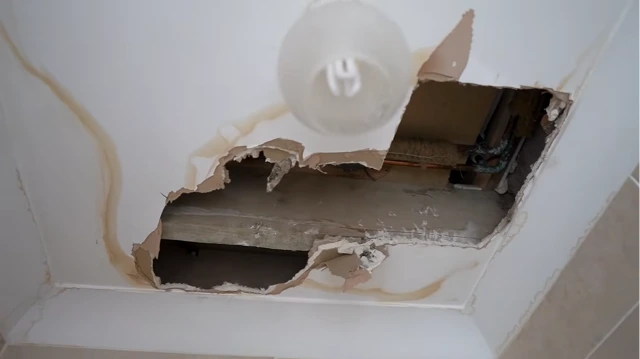
- Get the damage measured and written down. An assessment with moisture readings and a written scope gives your adjuster the full extent of the damage, including what spread past the visible stain. Ceiling leak assessment.
Claim process
How a Texas Ceiling Claim Moves, Step by Step
After you report the claim, Texas law puts your insurance company on a clock. The Prompt Payment of Claims Act, Chapter 542 of the Texas Insurance Code, sets deadlines the insurer must meet:
Within 15 days of receiving notice of your claim, the insurer must acknowledge it, start its investigation, and ask you for the documents and statements it needs.
Within 15 business days of receiving everything it asked for, the insurer must tell you in writing whether the claim is accepted or rejected. If it needs more time, it must explain why in writing, and it then has up to 45 days to decide.
Within 5 business days of telling you the claim is accepted, the insurer must pay.
If the insurer misses these deadlines without a valid reason, the law adds penalty interest on the claim amount, plus attorney fees. For most claims that interest is 18% a year. Claims for damage caused by forces of nature, such as hail, wind or a storm, fall under Chapter 542A of the same code instead, where the interest is the state judgment rate plus 5 percent, which usually works out lower. The deadlines above apply either way.
Your part of the process is shorter: report, document, let the adjuster see the damage before permanent repairs, and keep every paper. If your claim stalls past these deadlines, you can file a complaint with the Texas Department of Insurance.
Out-of-pocket cost
The Deductible Question: Is Filing Worth It?
Your deductible is the part of a covered claim you pay yourself, and in Texas it surprises people, because many policies carry a percentage deductible. The Texas Office of Public Insurance Counsel explains the trap in it: a percentage deductible is a percentage of your home’s insured value, not a percentage of your claim. On a home insured for $300,000, a 1% deductible is $3,000 out of your pocket before the insurer pays anything, whatever the size of the claim. Many Texas policies also carry different deductibles for different causes, so the number on your declarations page for wind and hail may not be the number that applies to a water claim. Read the declarations page, or ask your agent which deductible applies, before you decide.
Example deductible based on the home’s insured value, not the size of the ceiling repair claim.
The decision is then arithmetic. If the measured repair scope is close to or below your deductible, filing gains little and puts a claim on your record. If the damage runs well past the deductible, or water reached several rooms, filing is usually the right call. Two more points belong in the math. First, many policies pay a covered repair in two parts: an initial payment based on the depreciated value, with the balance released when the finished repairs are documented. Completed-work documentation is part of getting fully paid. Second, the repair cost itself is knowable before you file: our written assessment sets the scope and price first, so the deductible comparison is made with real numbers. The cost page explains what drives the size of a ceiling repair.
Our role
How We Support a Cedar Hill Claim
We do not file claims, and we do not decide them. Your insurer does, and any company that promises you a claim outcome is promising something it does not control. What we do is produce the record a claim is judged on, because it is the same record a proper repair needs:
- Dated photos of the damage as found, before anything is disturbed
- Moisture readings across the stain and well past it, showing how far the water actually spread, checked against ANSI/IICRC S500
- A written scope and price before work starts: what dries in place, what comes out, what gets rebuilt
- Readings and photos during drying, and a final record of the completed work, which is what releases the balance of a two-part payment
The assessment is a paid visit, and the fee is confirmed before the visit is booked. You take the documentation to your insurer or adjuster as your own record. And when the source of the leak belongs to another trade, we say so in writing too, which keeps the ceiling claim and the plumbing or roof bill cleanly separated, exactly how your insurer reads them. The full repair process sits on our water damage restoration page.
Frequently asked questions
Questions Cedar Hill Homeowners Ask Us About Insurance
How long do I have to file a water damage claim in Texas?
Report it as soon as you find it. Policies require prompt notice, and the Texas Department of Insurance specifically warns that hidden water damage usually must be reported within days of being discovered. Waiting is the riskiest move in a ceiling claim, because every quiet week lets the insurer read the leak as gradual. The dates on your photos and your assessment are the proof of when you found it.
Will filing a ceiling claim raise my premium?
It can. Insurers look at claim history when they price and renew policies, and water damage claims are among the ones they weigh heavily, because one leak often predicts another in the same house. That is not a reason to absorb a large loss yourself; it is a reason to run the deductible math first, with the real repair scope in hand, and file the claims that clearly clear it.
My claim was denied as a gradual leak. What can I do?
Ask for the denial reasons in writing; Texas law requires the insurer to notify you of a rejection, and the written reasons show what the decision turned on. Then check the dates: if the damage followed a sudden event and you reported it promptly, documentation showing when the leak was discovered, and readings showing the damage pattern, can support asking the insurer to look again. If the company missed the Chapter 542 deadlines or will not engage, a complaint to the Texas Department of Insurance is the next step, and an insurance agent or attorney can advise on your specific policy.
Does insurance cover mold that grows after a ceiling leak?
If mold develops on an item damaged by a covered event, the Texas Department of Insurance says that damage would be covered. Mold cleanup and testing as a separate service is usually not included in the policy, though it can often be added. Mold from a gradual leak or a flood is not covered, because the cause was not covered. Speed matters here for both reasons: drying within the first day or two is what keeps a covered water claim from becoming a mold problem at all.
Should I get the ceiling repaired before the adjuster visits?
Only temporary protection: stopping the water, drying, a tarp. The Texas Department of Insurance advises against permanent repairs until the insurance company has seen the damage, and damaged items should be kept for the adjuster to inspect. Drying is the exception that should not wait, because standing moisture enlarges the loss the insurer is being asked to pay for. Our drying work is checked by readings throughout, so the adjuster can see both the damage and the response. Ceiling drying.
Talk to Us About the Ceiling, and to Your Insurer About the Claim
Tell us which room is affected, what is above it, and when you first saw the damage. We will measure the full extent of it and put the scope and price in writing, and that written record is yours to take to your insurer, whether the claim is filed today or still being decided.
Call (972) 961-2680
110 E Belt Line Rd, Suite 300
Cedar Hill, TX 75104
Routine hours 7:00 AM to 8:30 PM daily.
Emergency service runs 24 hours.